Advice

How To Have Deeper Connections

How to Have Deeper Connections

Over on the podcast this week, Laura and I are talking about having deeper connections and more meaningful conversations with people.

The episode was inspired by this article about changing small talk into smart conversations, and this article on how to be polite. I for one, absolutely hate small talk. I’d much rather be in a corner somewhere reading my book than have to grasp at straws for conversation topics or talk about the weather. When I meet people that I can sense are kindred spirits, I’m usually a bit too enthusiastic to start talking to them about heartier topics.

In first year when I first met one of my closest friends, I’d only known her a few days before I sat down on her bed and asked her what she thought the meaning of life was. It’s a bit embarrassing now, but at the time all I knew was that my brain was starved of meaningful conversations after days of nothing but small talk, so the question just came out without me even thinking. Of course, she took it in stride and we’ve had plenty of deep (and shallow) conversations since.

I’m just like that – for better or for worse, I always try to take things to a deeper level. Sometimes it can get heavy, but most of the time it’s just comforting to talk about real feelings and hopes and goals with people that I trust. I don’t have a huge number of friends, but I am so lucky in that I know I could call any of the ones I do have right now and launch into some deep conversation and they’d be right there with me the whole time. The people I’m blessed to know have depth and layers and are able to really engage.

Since coming to Korea, it’s been great to know that I can form meaningful friendships on my own outside of university. That might seem like a “duh” statement, but to me it never felt like a sure thing. But being here, I’ve made some really true friends I’m able to talk to as if I’ve known them forever. It’s a pretty beautiful thing.

In the episode we talk about how to have more meaningful conversations, how to foster deeper connections with strangers, and how to take your friendships to another level. You can listen to the episode and find out more here.

How To Stay Above The Line

The Line

On the podcast today, Laura and I are discussing “The Line”, a concept she introduced me to a few months ago. The idea is this: there is an imaginary horizontal line running through your life that you can be above or below at any given time.

Below, you’re a lesser version of yourself – jealous, insecure, petty, rude, afraid, playing the victim, feeling sorry for yourself, blaming, whining, moping, criticizing, and otherwise being a small person. Above of course you’re the best version of yourself – generous, kind, compassionate, patient, optimistic, present, helpful, aware, taking responsibility, and acting and reacting gracefully. When you’re below the line, you allow your circumstances to drive and justify bad behaviour. When you’re above the line, you recognize that bad things will happen, but your reaction to them is your responsibility alone.

What I love most about this concept is that it’s so intuitive. I think most people, myself included, can tell when they’re below the line. I personally can feel it almost physically, it’s this sense of guilt or shame or disappointment in myself that I feel in my gut when I’ve acted or reacted in a below-the-line kind of way. And we can also tell when we’ve been above the line, because it feels good to be above.

How To Stay Above the Line

It’s so normal to be below the line, and so human to have automatic reflex reactions to negative situations based on our fears and insecurities. It’s much harder to act gracefully when bad things happen, to flip your script to get some perspective and practice gratitude. It’s the struggle of our lives, most definitely. We don’t have to stay above the line all the time (and we probably couldn’t even if we tried our darnedest) but we do have to try. We do have to try and stay present and aware to how we’re acting and use our internal compass to tell us which side of the line we’re on. We have to fight against our automatic tendencies and patterns. We have to try and live above the line and only make short visits below. It’s really very hard, but it’s also the whole point if we want to be the best versions of ourselves.

I’ve been finding it so helpful to just have this metaphor and language to use in everyday life. Today as I was running at the track, annoyed over and over again by all the oblivious walkers taking up the whole width, my internal monologue was something like “thelinethelinethelinethelinetheline”. It helped me shift my focus to my funny podcast and the lovely breeze, and reminded me to practice compassion and just do the best that I could under the circumstances.

In the elevator coming home it was sweaty tired me and a pursed-lipped older woman, but as I was avoiding eye contact, already thinking ahead to all the things I had to do before work, I thought “thelinethelinetheline” and looked up at her. She smiled and laughed, mimed running, and said some things in Korean I wish I could understand before getting off on her floor. That’s all, that’s the whole story. It won’t change my day or hers, but it was a little moment we shared, a small pocket of human connection. Both of us were above the line – being open instead of closed, friendly instead of avoidant, kind instead of annoyed.

You can listen to the whole episode, which includes our tips for staying above the line as much as possible, right here.

Q&A: How to Blog While Backpacking

How To Blog While Backpacking

How easy has it been for you to blog so far [while you’ve been travelling], especially with just an iPad Mini? If you don’t mind me asking, which app are you using to help you blog?      -Jan

I got this question in a comment and answered it already, but I thought it was definitely worth expanding on in a full post.

While I was away on my trip, I used blogging as a way to keep my family and friends back home updated with what I was up to. Since I wasn’t sending out lengthy emails and was constantly on the move, blogging felt like an efficient way to keep everyone in the loop. Also, since I’ve been writing about my life online for almost ten years (before this blog I was on WordPress, and before that Livejournal, ha!) it feels more unnatural not to blog at this point. Whenever I go too long without using words and photos to express myself, I start to feel lost and out-of-sorts. Which brings me to my first piece of advice:

Choose a way of documenting your trip that works for you.

How To Blog While BackpackingBlogging on the road can be kind of challenging at times. Since I’ve been blogging for so long, I know how to fix typos from my phone, and how to easily edit the back-end html of my posts if something doesn’t look right. I’ve had lots of practice with typing out blog posts and hitting publish, so in general it doesn’t take me very long to write new content. But if it’s brand new for you as you start your trip, you might get frustrated along the way and give up if it starts to suck up too much of your time. After all, you’re on a trip to experience brand new parts of the world, not to sit around in internet cafes hitting your head against the proverbial wall because your latest post just went up in a puff of smoke.

But I think documenting is so important! Preserving memories is such a great way to process and appreciate them, and of course to have them for later. So that’s why I would definitely recommend looking at different types of documentation if blogging isn’t your thing. In the past, I’ve kept a scrapbook on trips, similar to Austin Kleon’s tour notebook. When a friend of mine went on an exchange to France, she wrote weekly emails to her family and friends that were full of anecdotes and photos. A lot of people I met on my travels were keeping a photo blog on Tumblr, and others are just consistent about uploading photos to Facebook or Instagram with detailed captions. Whatever you choose, make sure it’s a method you’re comfortable with that’s easy for you to keep updated, and remember to:

Keep it simple!

When I was blogging on my trip, the whole process consisted of uploading photos to my Flickr account, pulling them into a blog post, and adding a few paragraphs worth of memories and favourite places I’d visited. I didn’t include any links, I rarely wrote captions for the photos, and sometimes I wrote very little. But the pictures spoke for themselves and I was happy to just get everything written down and shared with my loved ones back home. Almost one year later almost 100% of the names of all the restaurants and areas I loved in each city have disappeared entirely from my mind, but I would have been devastated to lose them forever. My sister spent this past semester gallivating around Europe and she was able to visit several of my favourite places because I got them written down in this simple form.

It reminds me a lot of one of my favourite sentiments: “Don’t let the perfect be the enemy of the good,” meaning done is better than perfect.

Pick good tools.

How To Blog While Backpacking

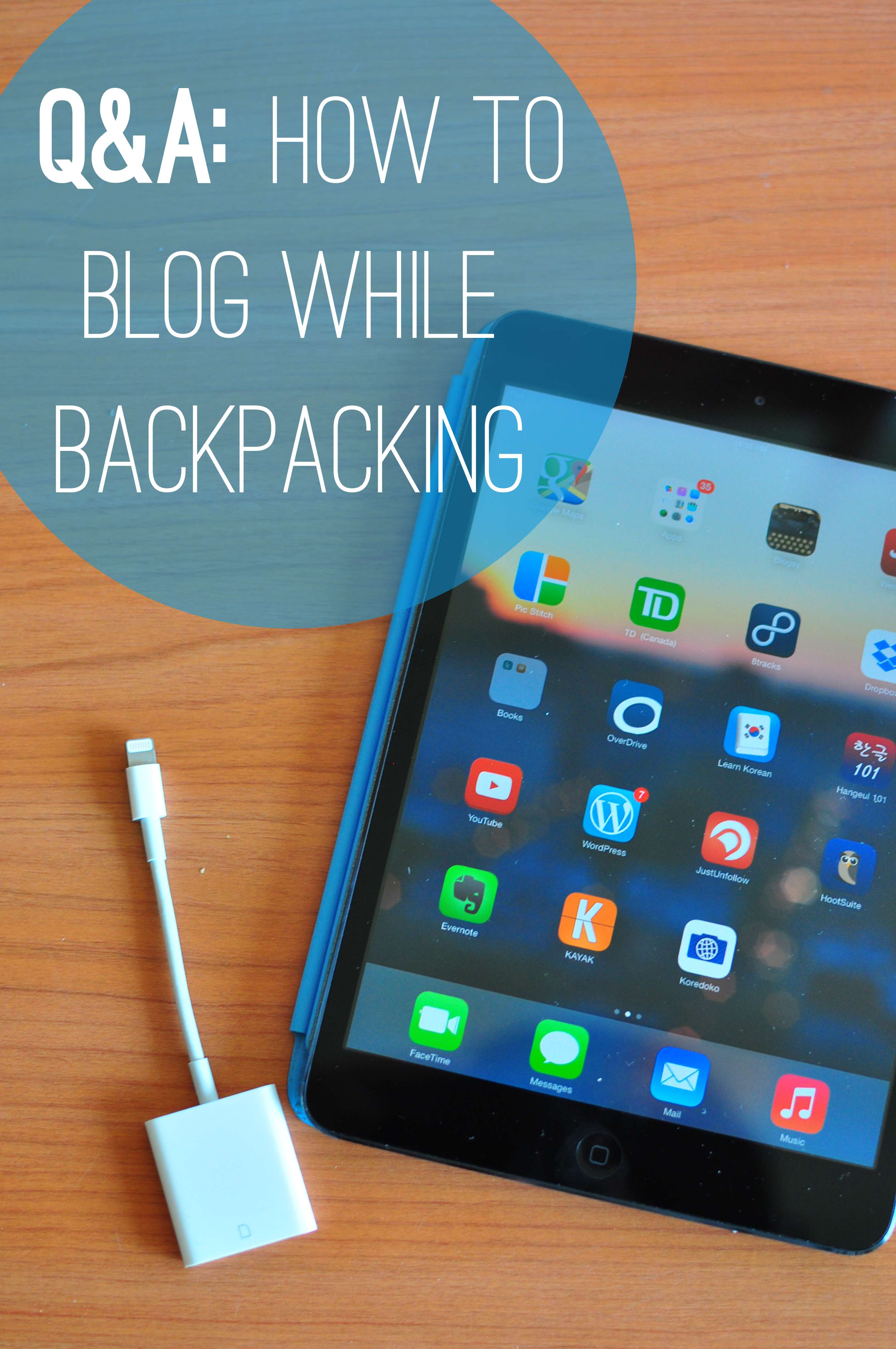
For the record, blogging from my iPad mini was totally fine. Definitely at times I missed having a full keyboard and some other features I like to use on my computer, but since I kept my posts so simple it wasn’t usually a problem. I realize that an iPad isn’t a traditional thing to bring backpacking and that it’s definitely a specialty item. Mine was a graduation gift from my father and I wouldn’t have been able to afford it on my own otherwise. But regardless of what technology (if any) you bring, you can still blog.

If you’re using a tablet, I would recommend buying an SD card reader for your device. This lets you totally sidestep the need to put photos from your camera onto a computer and saves you a ton of time. My card reader sometimes had a few issues but most of the time got the job done and couldn’t have been simpler to use. I have this iPad-specific one, but I’m sure there are similar products for other tablets.

I absolutely adore the Blogsy app. This one is specific for iPad, but I have also had great experiences with the WordPress app which is available on many different platforms for both phones and tablets. My favourite feature of Blogsy is that you can pull in photos from other social media platforms like Flickr and Instagram. Since I don’t have a mouse for my tablet, this drag-and-drop feature made my life a lot easier.

Before I received my iPad as a gift, I was planning to blog using only my phone and computers at hostels or internet cafes. If you choose this option, just make sure you bring a USB stick to keep your photos on and either a USB SD card reader to attach to the computer or your camera’s USB cord in order to upload your photos. I think this is definitely a good option as long as you test your tools before you leave and remember to keep it simple!

***

I hope that helps! I absolutely love reading and looking at accounts of people’s travels, and I always say the more blogs the better. Memory keeping can be so valuable, so long as it doesn’t interfere too much with making the memories themselves.

If you have any more questions on this or any other topic, let me know in the comments or by email: stephanie @ lifeinlimbo.org. And if you have had success blogging while travelling, I’d love to hear your method! Add your thoughts to the conversation in the comments below.

Resources for Planning Your Backpacking Trip Through Europe

Resources1It’s I’ve learned a lot about booking hostels, navigating new cities, making friends, and packing. I’m happy to say that I’m a much better traveller than I was one year ago today. My travel knowledge has come from a lot of trial and error, a lot of great information from fellow travellers and friends, and most of all, a lot of awesome resources. I’m very Type A and a planner by nature, and I love nothing more than falling down rabbit holes on the internet while researching various things. My Google Docs spreadsheet for Europe had no less than eleven different sheets!

I wanted to share some of my favourite websites and articles to inspire you and help you plan an adventure of your own.

Inspiration For Your Trip

DSC_0036_7Almost Fearless:

Adventurous Kate:

General Travel Tips

Legal Nomads: World Travel Resources – an incredibly helpful, very comprehensive guide to world travel.

Rick Steves: His travel tips section is full of great, very useful information.

Yes and Yes: There are tons of awesome posts in her travel category including 18 super-helpful travel tips.

The Savvy Backpacker: Lots of great articles and resources for planning a budget backpacking trip.

Nomadic Matt: How to Legally Stay in Europe for More Than 90 Days (a very helpful article about visas and permitted lengths of stay).

Packing for Europe & Travelling Light

DSC_0149One Bag: The absolute ultimate light packing guide. It has tips on why packing light is a smart choice, a universal light packing list with detailed, and in-depth explanations of why each item on the list is helpful or important. I lost hours to this website.

One Bag One World: Forums and tips on travelling light. I love the old website, but the new one is good too. You can find the new one here.

Her Packing List: Awesome packing lists, backpack and product reviews and resources.

PB Fingers: What To Pack To Europe (aimed at women, for summer travel)

Rick Steves: A light packing list and tips on packing smart and travelling light.

Never Ending Voyage: How to travel long-term with carry-on luggage, and their complete, updated packing list.

Favourites

Ulmon Apps: The ultimate travel app for most major cities. It lets you navigate in real time even without an internet connection, lists all major attractions within the app and sometimes even has integration with the local subway system so you can see which metro stop to get off at for wherever you’re going. I absolutely adore these apps and they are my #1 recommended travel tip. Plus, somehow they’re free.

Hostel World: I love this website and never used anything else to read reviews of hostels and book my accomodations.

Blogsy: A blogging app for iPad, perfect for blogging while travelling.

Oanda Currency: An awesome currency converter app that you can use even when you have no internet connection.

Solo Travel

DSC_0164_2Twenty-Something Travel: The Introvert’s Guide to Travel, and a good reason to travel solo.

Refinery 29: I Travel to Feel Lonely…On Purpose – a really great, fresh perspective on solo travel.

Legal Nomads: The Solo Female Travel Experience, and the same topic, revisited with helpful tips.

Fluent in 3 Months: Is Long-Term Solo Travel Lonely?

A Little Adrift: Yes, Sometimes Travel Is Lonely.

The Ramble: Awesome advice if you’re worried about getting lonely while travelling.

European Destinations

Italy:

Paris:

Croatia: 15 Things To Do in Dubrovnik

***

Taking myself on a trip through Europe is one of the best things I’ve ever done. I was able to see some of the most beautiful places in the world, meet some awesome people, and most of all gain lots of confidence for both travelling and living the life I want to live. I’d recommend it to anyone. You don’t need a travel partner, you don’t need to be ready, everything is figureoutable, you can do this. It’s almost a year later but the experiences I had on my trip are still giving back to me in ways I never could have predicted.

This is a very incomplete list of resources, of course. I’ll try to add more as I remember them or as questions come up. If you have any specific questions about my trip, check out my FAQs, my posts on tips for travelling through Europe and for doing it solo, or send me an email at stephanie @ lifeinlimbo.org.

Thanks for reading. Good luck and have fun on your trip!

Scroll to Top